
"coffee yield per hectare"
800 article(s) found

Brand introduction-which brand of Vietnamese coffee beans is G7 coffee the best coffee beans in Vietnam?
Professional coffee knowledge exchange more coffee bean information please follow the coffee workshop (Wechat official account cafe_style) Vietnamese coffee Vietnam location is very conducive to coffee cultivation, Saigon coffee products used in each bean, are selected from the best coffee areas in the Vietnamese plateau, with special cream refined baking, outstanding cream, coffee mellow, coffee

High-quality coffee bean producing countries recommend Guatemala
The extra-hard coffee beans here are full-grained, delicious and balanced, and the pure Guatemala coffee once enjoyed a reputation as the best quality coffee in the world, but its quality also declined for a time. However, it is gratifying that its reputation is gradually being restored. In 1750, Father Jesuit introduced coffee trees to Guatemala and Germany at the end of the 19th century.

Introduction to the method of taste treatment in the producing area of Costa Rican coffee
Coffee was introduced into Costa Rica from Cuba in 1729. Today, its coffee industry is one of the well-organized industries in the world, with a yield of 1700 kg per hectare. Costa Rica has only 3.5 million people but 400m coffee trees, and coffee exports account for 25 per cent of the country's total exports. The volcanic soil of Costa Rica is very fertile and well drained, especially in the central part.

Vietnamese boutique coffee flavor taste manor production area introduces Vietnamese coffee brands
Vietnam's geographical location is very favorable for coffee cultivation. Southern Vietnam has a hot and humid tropical climate, which is suitable for growing ROBUSTA coffee, while the north is suitable for growing ARABICA coffee. Coffee production in Vietnam has the following characteristics: (1) because there is no effective way to deal with fallen leaves, medium-grain coffee was selected as the main variety in the early 1980s. (2) take planting technology as

Introduction to the characteristics and stories of Arabica bourbon and common bourbon varieties
I believe that many friends will marvel at the huge system of growing coffee beans when they first come into contact with coffee. Like Kaddura, a common coffee bean in Latin American coffee producing areas, it is naturally mutated from a bourbon variety, so what other varieties of bourbon coffee? With this doubt, please follow the editor into today's coffee knowledge popularization, Jane of the bourbon family and his mutant family.
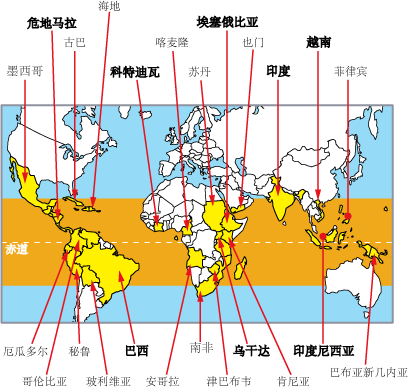
Coffee producing area 53 global coffee producing area Guatemala 53 coffee producing area
Here in Guatemala, the extra-hard coffee beans are full-grained, delicious and balanced, and the pure full-bodied Guatemalan coffee once enjoyed a reputation as the best quality coffee in the world, but its quality also declined for a time. However, it is gratifying that its reputation is gradually being restored. In 1750, Father Jesuit introduced coffee trees to Guatemala.

Taste characteristics of Costa Rican Coffee Manor with unique strong Flavor
Coffee was introduced into Costa Rica from Cuba in 1729. Today, its coffee industry is one of the well-organized industries in the world, with a yield of 1700 kg per hectare. Costa Rica has only 3.5 million people but 400m coffee trees, and coffee exports account for 25 per cent of the country's total exports. The volcanic soil of Costa Rica is very fertile and well drained, especially in the central part.
An introduction to Guatemalan coffee beans the origin of Guatemalan coffee beans the characteristics of Guatemalan coffee beans
Coffee production in Guatemala has declined relatively, at 700kg per hectare, while that in El Salvador is 900kg per hectare and that in Costa Rica is even more astonishing, at 1700 kg per hectare. The export of dangerous Dimara coffee is controlled by private companies, but the National Coffee Council (Asociacion Nacional de Cafe) controls the coffee industry.

Which brand of Vietnamese coffee is good? Vietnamese coffee introduction
Following Cafe Review (Wechat official account vdailycom) found that the representative products of Vietnamese coffee opened by Beautiful Cafe are MOOSSY Coffee, TRUNGNGUYEN Coffee, Saigon Coffee and HIGHLANDS Coffee. The geographical location of Vietnam is very favorable for coffee cultivation. Southern Vietnam has a hot and humid tropical climate, which is suitable for growing ROBU.

Introduction to the producing areas of Coffee Yerzaro, Costa Rica, the characteristics of Grinding degree and the method of treatment
Coffee was introduced into Costa Rica from Cuba in 1729. Today, its coffee industry is one of the well-organized industries in the world, with a yield of 1700 kg per hectare. Costa Rica has only 3.5 million people but 400m coffee trees, and coffee exports account for 25 per cent of the country's total exports. The volcanic soil of Costa Rica is very fertile and well drained, especially in the central part.

Introduction to the flavor and taste of Ethiopian boutique coffee beans and the characteristics of the manor producing area
A large amount of coffee production (95%) is done by small shareholders, with an average yield of 561 kg per hectare. For centuries, minority holders of Ethiopian coffee farms have been producing a variety of high-quality types of coffee. The secret of producing high-quality coffee is that coffee farmers have developed the right environment through generations of repeated learning about the coffee planting process.

What is the price, flavor, taste, variety and quality of Vietnamese coffee bean brands? introduction to the manor producing area
Vietnam's geographical location is very favorable for coffee cultivation. Southern Vietnam has a hot and humid tropical climate, which is suitable for growing ROBUSTA coffee, while the north is suitable for growing ARABICA coffee. Coffee production in Vietnam has the following characteristics: (1) because there is no effective way to deal with fallen leaves, medium-grain coffee was selected as the main variety in the early 1980s. (2) take planting technology as

Introduction of Manor in Fine Coffee Bean Flavor and taste producing area of Vietnam
Vietnam's geographical location is very favorable for coffee cultivation. Southern Vietnam has a hot and humid tropical climate, which is suitable for growing ROBUSTA coffee, while the north is suitable for growing ARABICA coffee. Coffee production in Vietnam has the following characteristics: (1) because there is no effective way to deal with fallen leaves, medium-grain coffee was selected as the main variety in the early 1980s. (2) take planting technology as

There is a rich fragrant Hawaiian Kona coffee that introduces fine coffee.
The climate is very suitable, the sun in the morning gently passes through the air full of water vapor, in the afternoon, the mountains will become more humid and foggy, and the white clouds surging in the air are natural umbrellas for coffee trees, and the evening will become sunny and cool. Suitable natural conditions make the average yield of Kona coffee very high, reaching 2240 kg per hectare, while in Latin American coffee.

Salvadoran coffee features Salvadoran coffee flavor
In the early 1990s, guerrilla warfare greatly damaged the country's national economy, reducing coffee production from 3.5 million bags in the early 1970s to 2.5 million bags in 1990-1991. The eastern part of the country was most affected by guerrilla warfare, and many farmers and workers were forced to leave the manor. The shortage of funds has led to a sharp drop in coffee production, from 1200 kg per hectare in the past to no yield per hectare today.

Introduction to Costa Rican Yersalo Coffee Flavor Manor with light and pure flavor
Coffee was introduced into Costa Rica from Cuba in 1729. Today, its coffee industry is one of the well-organized industries in the world, with a yield of 1700 kg per hectare. Costa Rica has only 3.5 million people but 400m coffee trees, and coffee exports account for 25 per cent of the country's total exports. The volcanic soil of Costa Rica is very fertile and well drained, especially in the central part.

El Salvador coffee origin producing area
In the early 1990s, guerrilla warfare greatly damaged the country's national economy, reducing coffee production from 3.5 million bags in the early 1970s to 2.5 million bags in 1990-1991. The eastern part of the country was most affected by guerrilla warfare, and many farmers and workers were forced to leave the manor. The shortage of funds has led to a sharp drop in coffee production, from 1200 kg per hectare in the past to no yield per hectare today.

Ministry of Agriculture: Coffee plantations must be replanted to increase coffee production by 50%
Professional barista exchanges please pay attention to coffee workshop (Weixin Official Accounts cafe_style ) Ministry of Agriculture (Kementan) promises to increase coffee production nationwide, because Indonesia ranks only 4th in the world in coffee production, with an average annual output of 0.6 tons per hectare. Based on that production, Indonesia produced just 691, 000 tonnes of coffee last year, well below Colombia's 840, 000 tonnes and Vietnam's 1.6 million tonnes

Introduction to the History of planting and Development of Maraka Dula Coffee varieties in Nicaragua
For the exchange of professional baristas, please pay attention to the coffee workshop (Wechat official account cafe_style). Monte Cristo Manor Nicaragua Finca Cerro de Jesus of Nicaragua is adjacent to the Cordillera Dipilto Mountains of Honduras in the north of Nicaragua. Monte Cristo Manor is located at the highest peak in this mountain range, covering an area of 280ha, of which 126ha is used for cultivation.